Lith Corporation, founded in 1998 by a group of material science doctor from Tsinghua University, has now become the leading manufacturer of battery lab&production equipment. Lith Corporation have production factories in shenzhen and xiamen of China.This allows for the possibility of providing high quality and low-cost precision machines for lab&production equipment,including: roller press, film coater,mixer, high-temperature furnace, glove box,and complete set of equipment for research of rechargeable battery materials. Simple to operate, low cost and commitment to our customers is our priority.
Thermal Evaporation Coaters: Precision Equipment for High-Quality Thin Film Deposition
Overview
Thermal Evaporation Coaters are advanced vacuum deposition systems widely used for the fabrication of thin films in scientific research and industrial manufacturing. Based on the principle of physical vapor deposition (PVD), thermal evaporation involves heating a solid material in a high-vacuum environment until it vaporizes and subsequently condenses onto a substrate, forming a uniform thin film layer. These systems are essential tools in fields such as microelectronics, optics, materials science, and nanotechnology.
Thermal evaporation technology is valued for its simplicity, high purity, and precise control of film thickness. By maintaining a controlled vacuum environment, contamination from air molecules is minimized, enabling the deposition of clean and high-quality films. Modern Thermal Evaporation Coaters are designed to provide stable performance, accurate monitoring, and repeatable coating processes, making them indispensable for both laboratory research and industrial-scale production.
Features
Thermal Evaporation Coaters are equipped with a variety of technical features that enhance their reliability, efficiency, and versatility:
1. High-Vacuum Chamber
The vacuum chamber is the core component of the system. It maintains a low-pressure environment that allows evaporated atoms to travel freely from the source to the substrate without significant collision with gas molecules.
2. Evaporation Sources
Thermal evaporation systems use different heating sources such as resistive heating boats, filaments, or crucibles. These sources are designed to heat the target material until it reaches its evaporation temperature.
3. Thickness Monitoring System
Many systems include quartz crystal microbalance (QCM) sensors that monitor film thickness and deposition rate in real time, ensuring accurate and repeatable coatings.
4. Substrate Holder and Rotation Mechanism
Substrate holders often include rotation or tilting mechanisms that improve coating uniformity across the surface.
5. Temperature and Power Control
Advanced power supplies allow precise control over heating rates and evaporation intensity, enabling users to tailor film properties.
6. User-Friendly Interface and Automation
Modern coaters often include programmable control systems and digital interfaces that allow operators to set deposition parameters and run automated coating cycles.
Process
The thermal evaporation coating process involves several carefully controlled steps. First, the substrate and source material are placed inside the vacuum chamber. The chamber is then evacuated using vacuum pumps to achieve a high-vacuum environment, typically in the range of 10⁻⁵ to 10⁻⁷ torr.
Once the required vacuum level is reached, the evaporation source is heated using an electric current. The heat causes the source material to melt and then vaporize. The vaporized atoms travel through the vacuum and deposit onto the substrate surface, forming a thin film layer.
During deposition, parameters such as evaporation rate, substrate temperature, and deposition time are carefully monitored and controlled. Thickness monitoring systems provide real-time feedback to ensure the coating reaches the desired thickness. After deposition is complete, the system is cooled and the chamber is vented before removing the coated substrates.
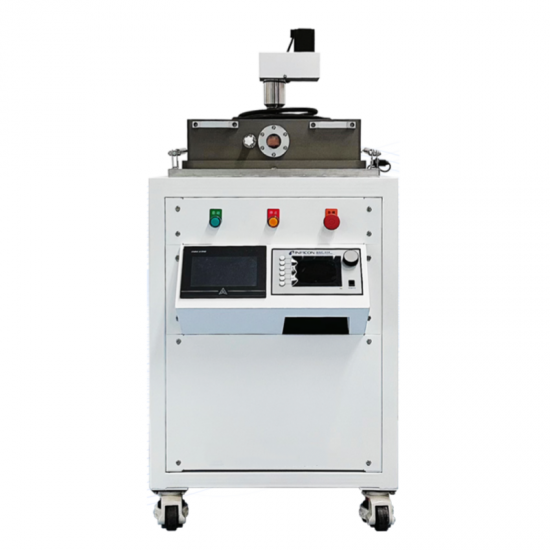
PVD Thermal Evaporator
Applications
Thermal Evaporation Coaters are used across numerous scientific and industrial applications:
* Microelectronics and Semiconductor Manufacturing
Deposition of metal contacts, electrodes, and conductive layers in integrated circuits and electronic devices.
* Optical Coatings
Fabrication of reflective mirrors, anti-reflective coatings, optical filters, and thin films used in lenses and laser systems.
* Nanotechnology and Materials Research
Production of nanoscale thin films for experimental studies on electrical, magnetic, and optical properties.
* Solar Energy and Photovoltaics
Deposition of thin metallic layers and conductive coatings used in solar cell structures.
* Surface Analysis Preparation
Preparation of conductive coatings on non-conductive samples for scanning electron microscopy (SEM).
Advantages
Thermal Evaporation Coaters offer several advantages compared with other thin film deposition techniques:
1. High Purity Films
The vacuum environment and simple evaporation mechanism minimize contamination, resulting in high-purity coatings.
2. Precise Thickness Control
Integrated monitoring systems enable accurate control of film thickness and deposition rate.
3. Uniform Coating Quality
Substrate rotation and optimized chamber design ensure consistent film deposition.
4. Versatility of Materials
A wide range of metals and some compounds can be evaporated and deposited as thin films.
5. Relatively Simple Operation
Compared with more complex deposition technologies, thermal evaporation systems are easier to operate and maintain.
6. Scalability
These systems can be designed for small laboratory experiments as well as large industrial production lines.
Conclusion
Thermal Evaporation Coaters represent a critical technology in modern thin film deposition. Their ability to produce uniform, high-purity coatings with precise thickness control makes them indispensable in electronics, optics, materials science, and renewable energy industries. By combining reliable vacuum systems, advanced monitoring technologies, and flexible evaporation sources, these machines deliver consistent and high-quality coating results.
As technological demands continue to increase, Thermal Evaporation Coaters are evolving with improved automation, better process control, and enhanced scalability. These advancements ensure that thermal evaporation remains one of the most important and widely used methods for thin film fabrication, supporting ongoing innovation in both research and industrial manufacturing.


 +86 13174506016
 Louis@lithmachine.com
 +86 18559646958
 18659217588
 English ▼


